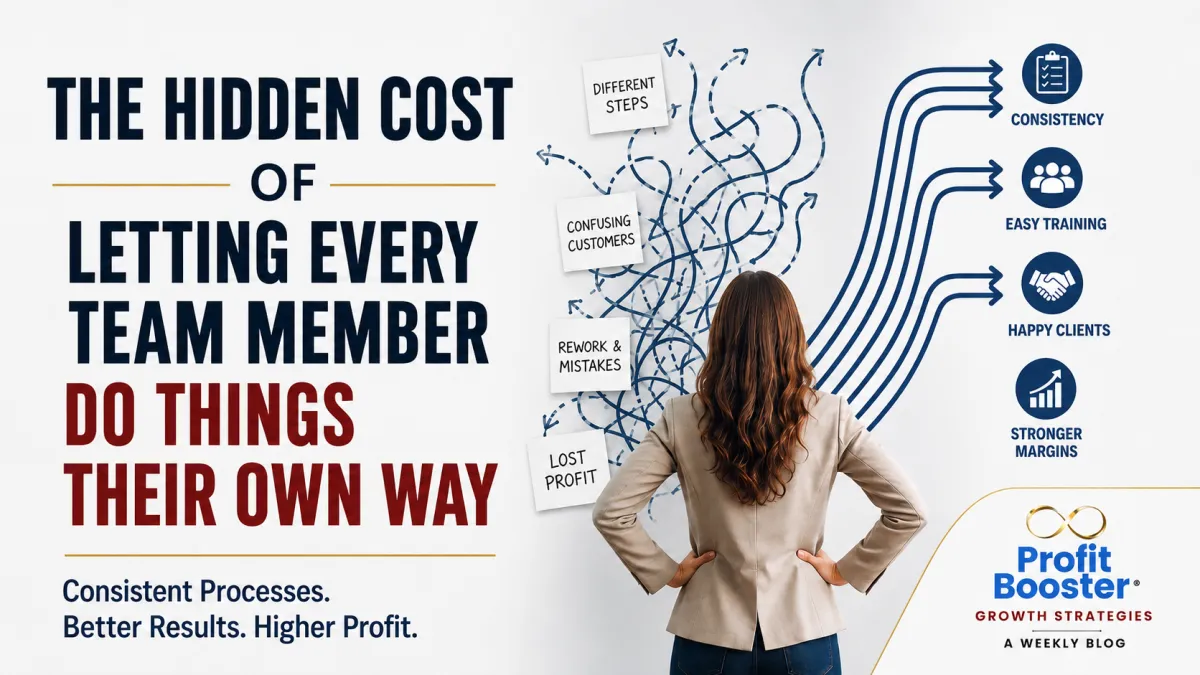
The Hidden Cost of Letting Every Team Member Do Things Their Own Way
The Hidden Cost of Letting Every Team Member Do Things Their Own Way
A little flexibility inside a business can be a good thing.
Your people should be able to think, make decisions, and use good judgment without asking you how to handle every tiny detail.
But there is a big difference between giving your team autonomy and allowing everyone to invent their own way of doing the work.
When the same task is handled five different ways by five different people, you do not have flexibility.
You have operational inconsistency.
And while it may not show up as an obvious line item on your P&L, it can quietly make your business more expensive to run.

The Problem Is Bigger Than "That's Not How I Do It"
Business owners often notice process inconsistency when something goes wrong.
A customer receives different information depending on who answers the phone.
One employee creates a detailed proposal while another sends three sentences in an email.
Someone follows up with a prospect the next day. Someone else waits a week.
One team member completes every step in onboarding. Another skips the parts they do not think are necessary.
Individually, these may seem like small differences.
Collectively, they create friction throughout the business.
That friction costs money.
The team spends more time correcting mistakes. Customers need additional explanations. Managers answer questions that should already have clear answers. New employees learn habits from whoever happens to train them instead of learning the company's preferred process.
Eventually, the business starts operating on tribal knowledge rather than scalable business systems.
That works until it doesn't.
Inconsistency Creates Rework You Rarely Measure
One of the biggest hidden costs inside a business is rework.
Rework happens when something has to be corrected, clarified, redone, rescheduled, resent, or explained because the original process was incomplete or inconsistent.
Most companies do not track it.
An employee spends 20 minutes fixing an invoice.
Another spends 30 minutes explaining something to a confused customer.
A manager spends an hour correcting a proposal.
Someone else recreates a document because they could not find the latest version.
None of those situations look catastrophic.
But multiply them across your team, every week, for an entire year.
Now you have real margin erosion.
This is why business process improvement should not be viewed only as an efficiency exercise. Better processes protect profitability.
Every unnecessary touch costs something.
Your Customers Notice the Inconsistency Too
Operational consistency affects more than your internal team.
Customers feel it.
They may not say, "Your company lacks standardized processes."
They simply feel like the experience is unpredictable.
They wonder why one employee told them something different from another.
They wonder why their friend's project moved smoothly while theirs feels confusing.
They wonder why they have to keep providing information they already gave someone else.
Those moments chip away at confidence.
A consistent customer experience tells people that your business knows what it is doing.
That does not mean every conversation should sound scripted or every customer should receive identical treatment.
It means the important parts of the experience should not depend on which employee happens to be working that day.
Training Gets Harder When Everyone Has Their Own Method
There is another expensive side effect that tends to appear as businesses grow.
Training becomes painfully inefficient.
When there is no clearly defined process, a new employee does not really learn "the company way."
They learn Sarah's way.
Or Mike's way.
Or whoever had time to train them.
Then that employee eventually trains someone else, adding another variation along the way.
Before long, you have a workplace version of the telephone game.
This is often where owners become frustrated because the team "should know how to do this by now."
But if there has never been a consistent process to follow, what exactly should they know?
Operational consistency makes expectations teachable.
And teachable systems are what allow a company to grow without requiring the owner or a long-time employee to personally supervise every detail.
Standardization Does Not Mean Turning People Into Robots
This is where some business owners hesitate.
They worry that systems will make the company rigid.
Good systems do the opposite.
A strong process defines the repeatable pieces so your team has more capacity to think about the exceptions.
For example, your team should not have to reinvent the onboarding checklist for every new customer.
They should not have to decide which information belongs in every proposal.
They should not have to remember when a sales follow-up should happen.
Those steps can be standardized.
Then your people can use their judgment where judgment actually adds value.
That is the balance you want.
Consistency in the process.
Human thinking inside the process.
Scalable Businesses Are Easier to Run Because the Business Remembers
A scalable business does not rely on individual memory to keep everything moving.
The systems remember.
The workflow prompts the next step.
The checklist protects important details.
The CRM tracks follow-up.
The operating procedure creates consistency.
The team knows what "done correctly" looks like.
That is the foundation of scalable business systems.
And it does more than improve efficiency.
It reduces owner dependency, improves training, creates a more consistent customer experience, protects margins, and makes future growth much easier to absorb.
Because growth does not fix operational inconsistency.
It multiplies it.
If your business feels harder to manage every time revenue increases, the answer may not be another employee.
You may need a better way of doing the work you already have.
Find the Systems That Are Costing You Profit
Not every process needs a 12-page SOP.
Start with the areas where inconsistency creates the biggest financial impact.
Look at sales follow-up, quoting, onboarding, service delivery, billing, customer communication, and internal handoffs.
Ask one simple question:
Would this task be completed roughly the same way if three different employees handled it today?
If the answer is no, you probably found an opportunity for business process improvement.
The Profit Booster® Growth Map helps you identify where operational gaps, revenue leaks, and growth constraints are holding your business back so you can prioritize the improvements that will have the greatest impact.
Build your Growth Map at https://profitbooster.biz/growthmap and get a clearer picture of what your business needs next to grow more profitably.
About the Author

Marcia Riner is the go-to guru for all things business growth and greater profitability. With over 25 years of experience under her belt, she's the brains behind Infinite Profit®, where she's the CEO and business growth strategist. Her Profit Booster® methodology is the secret weapon for entrepreneurs hungry for more profit, growth, and a killer exit strategy that helps businesses outperform in today's challenging market.
Marcia hosts a weekly podcast called Profit With A Plan, with videos on YouTube at www.YouTube.com/profitwithaplan and audio at www.profitwithaplan.com. She is constantly sharing business growth tips on all of her social channels @marciariner. You can also find her other blogs at www.infinite-profit.com/blog.