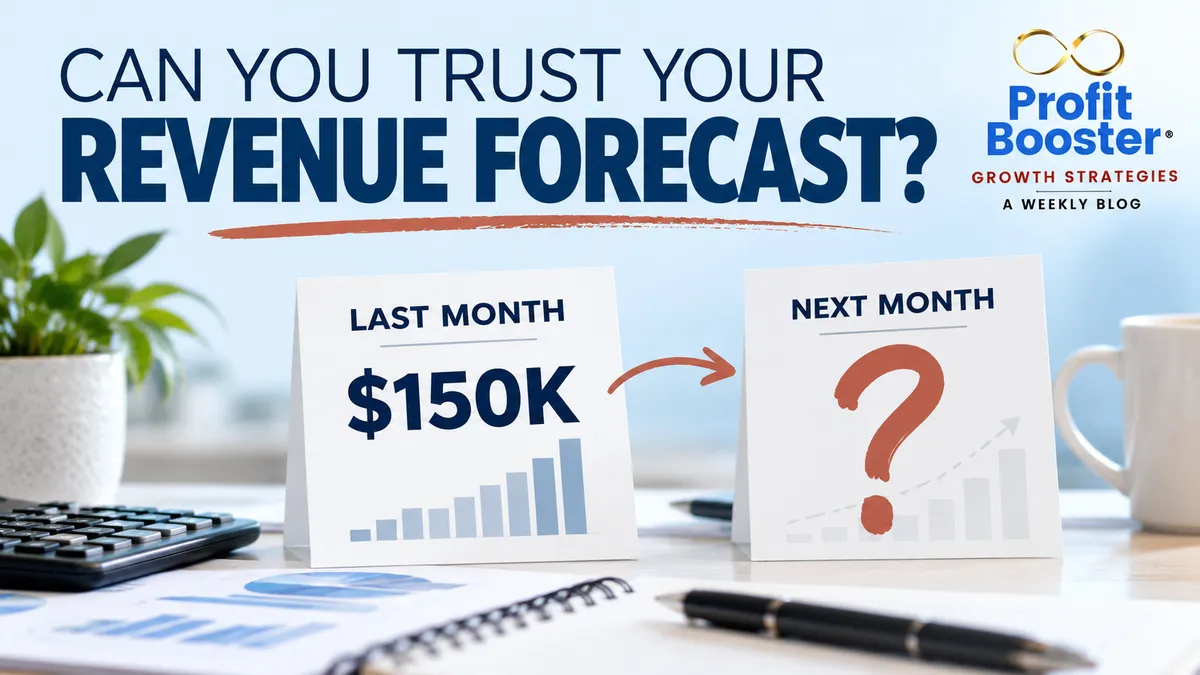
Your Business Has a Revenue Number. But Does It Have a Revenue Forecast You Can Trust?
Your Business Has a Revenue Number. But Does It Have a Revenue Forecast You Can Trust?
Profit Booster® Growth Strategies | October 23, 2026
By Marcia Riner | Business Growth Strategist & CEO, Infinite Profit®
You know what your business brought in last month. You probably know what you want it to bring in next month, too.
But here's a question worth asking: How much of next month's revenue can you actually count on?
There's a big difference between having a revenue goal and having a reliable revenue forecast.
One tells you what you're hoping to achieve. The other helps you make decisions about hiring, spending, capacity, and cash flow without crossing your fingers.
And for a growing business, that difference can get expensive.
Why Isn't Last Month's Revenue Enough to Predict Next Month?
Because yesterday's sales don't automatically become tomorrow's cash.
A business might generate $150,000 in sales one month and assume it's on track to repeat that performance. But what happens when a major customer delays a project, three proposals sit unanswered, or completed work takes another 45 days to get paid?
Suddenly, that $150,000 expectation looks very different.
This is where revenue forecasting for small business becomes more than a financial exercise. It's a practical way to see what's coming before it becomes a problem.
A useful forecast connects four things:
Sales pipeline: What opportunities are realistically likely to close?
Delivery capacity: Can your team fulfill the work on schedule?
Revenue timing: When will the work actually generate recognized revenue?
Cash collection: When will the money reach your bank account?
Miss one of these, and your forecast may look impressive while your cash flow tells another story.
Are You Forecasting Revenue or Just Adding Up Opportunities?
Here's a common mistake I see business owners make.
They have $300,000 in potential deals sitting in their pipeline. They need $100,000 in new sales next month, so they figure they're in good shape.
Not necessarily.
A proposal sent yesterday isn't the same as a contract awaiting signature. And neither is the same as a signed agreement with a confirmed start date.
Sales pipeline forecasting works best when you evaluate opportunities based on evidence, not enthusiasm.
Consider this example:
Pipeline opportunity | Deal value | Estimated close probability | Weighted forecast |
Proposal under review | $40,000 | 50% | $20,000 |
Verbal approval | $30,000 | 75% | $22,500 |
Early conversation | $50,000 | 20% | $10,000 |
Total | $120,000 | $52,500 |
Your pipeline shows $120,000, but your probability-weighted forecast is only $52,500.
That's a meaningful difference when you're making payroll commitments or deciding whether to invest in another employee.
And remember, the percentages are estimates. They become more dependable when they're based on your actual sales history.
What Makes a Revenue Forecast Reliable?
A reliable forecast isn't necessarily complicated. It just needs to reflect how your business actually operates.
Start with three categories.
1. Committed revenue
This includes signed contracts, recurring agreements, confirmed orders, and scheduled work that you reasonably expect to deliver.
2. Probable revenue
These are active opportunities with a demonstrated likelihood of closing, supported by buyer activity, realistic timelines, and your historical conversion rates.
3. Potential revenue
These are earlier-stage conversations, unqualified leads, and opportunities that could develop but aren't dependable enough to support spending decisions.
Keeping these categories separate prevents optimistic sales conversations from turning into premature financial commitments.
It also gives you a much better picture of predictable business revenue.
What Happens When Sales Forecasting Ignores Delivery and Cash Flow?
Let's say your sales team closes $80,000 in new business.
Great news, right?
Except your operations team can't begin the work for another six weeks. Your invoices go out after delivery, and customers have 30 days to pay.
You've made the sale, but the cash may not arrive for months.
Meanwhile, expenses keep moving.
That's why effective business revenue forecasting should include a delivery schedule and a cash collection forecast alongside projected sales.
Revenue growth and cash flow growth aren't always happening at the same speed.
When you can see those timing differences early, you can adjust expenses, staffing, payment terms, and project scheduling before cash gets tight.
How Can You Build a Better Revenue Forecast in 30 Minutes a Week?
You don't need an expensive forecasting platform to get started.
Set aside 30 minutes each week and review five questions:
What revenue is already committed for the next 30, 60, and 90 days?
Which pipeline opportunities have genuinely moved closer to closing?
What work can we realistically deliver during that period?
When will invoices be issued, and when do we expect payment?
What changed since last week's forecast, and why?
That final question is especially valuable.
If deals repeatedly close later than expected, or customers consistently pay beyond their terms, you've uncovered information that can improve your forecast and your business processes.
Over time, comparing forecasts against actual results makes your predictions more dependable.
The Real Advantage Isn't Predicting the Future. It's Preparing for It.
No revenue forecast will be perfect.
Customers change their minds. Projects get delayed. Unexpected opportunities appear.
But a business with a reliable forecasting process can respond faster and make better decisions.
Instead of wondering whether you can afford to hire, you can see the revenue and capacity supporting that decision.
Instead of reacting to a cash shortage, you can anticipate when collections may fall behind expenses.
And instead of managing your business through last month's results, you can start managing what happens next.
That's how revenue forecasting becomes a business growth strategy, not just another spreadsheet.
Ready to Turn Revenue Goals Into a More Predictable Growth Plan?
If your business has ambitious revenue goals but you're not entirely confident about what's coming next, it's time to look beyond the sales numbers.
The Profit Booster® Growth Map helps you identify what's supporting your growth, where revenue and profit may be leaking, and which opportunities deserve your attention first.
Because growing revenue is good. Building a business that can predict, deliver, and profit from that growth is even better.
Get your Profit Booster® Growth Map at ProfitBooster.biz/growthmap.
About the Author
Marcia Riner is a Business Growth Strategist and CEO of Infinite Profit®, where she helps growth-minded business owners increase revenue, improve profitability, and build businesses that are worth more.
With more than 25 years of experience, Marcia serves as a Growth Implementation Partner, helping entrepreneurs move beyond ideas and into measurable results. Through her Profit Booster® frameworks, strategic consulting, and Profit Booster® Growth Agency, she helps business owners strengthen sales, marketing, operations, and profitability while reducing their dependence on the owner.
Marcia is also the host of the Profit With A Plan podcast, where she shares practical strategies and interviews business experts on growth, profitability, and building long-term business value.
Connect with Marcia and explore more business growth strategies at Infinite-Profit.com, read her latest articles at Infinite-Profit.com/blog, or follow her on social media @marciariner.