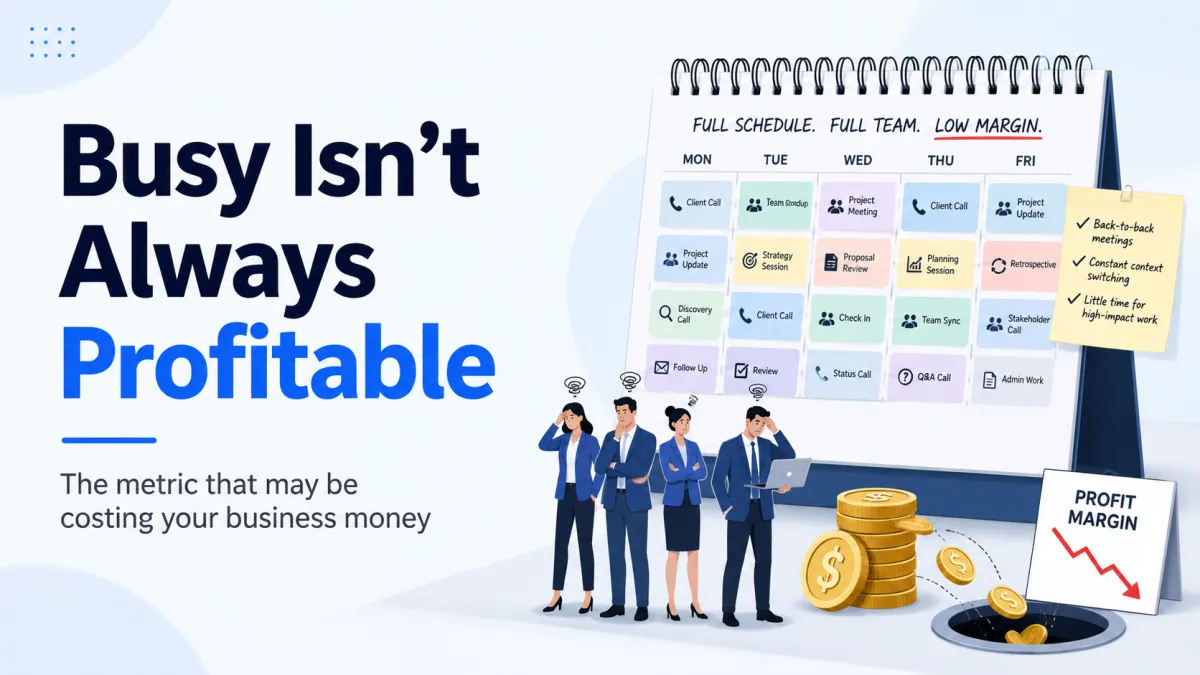
Your Team Is Busy. But Is That Busyness Making You Money?
Your Team Is Busy. But Is That Busyness Making You Money?
A packed calendar can look like progress.
Everyone is booked. The team is moving fast. Slack is active. Customers are being served. Meetings are stacked. Projects are in motion.
From the outside, the business looks productive.
But there is an important question most owners do not ask often enough:
Is all that activity actually producing profitable growth?
Because “busy” is not a business metric.
In fact, when everyone is constantly at capacity, it can be a warning sign that your business capacity planning needs attention.
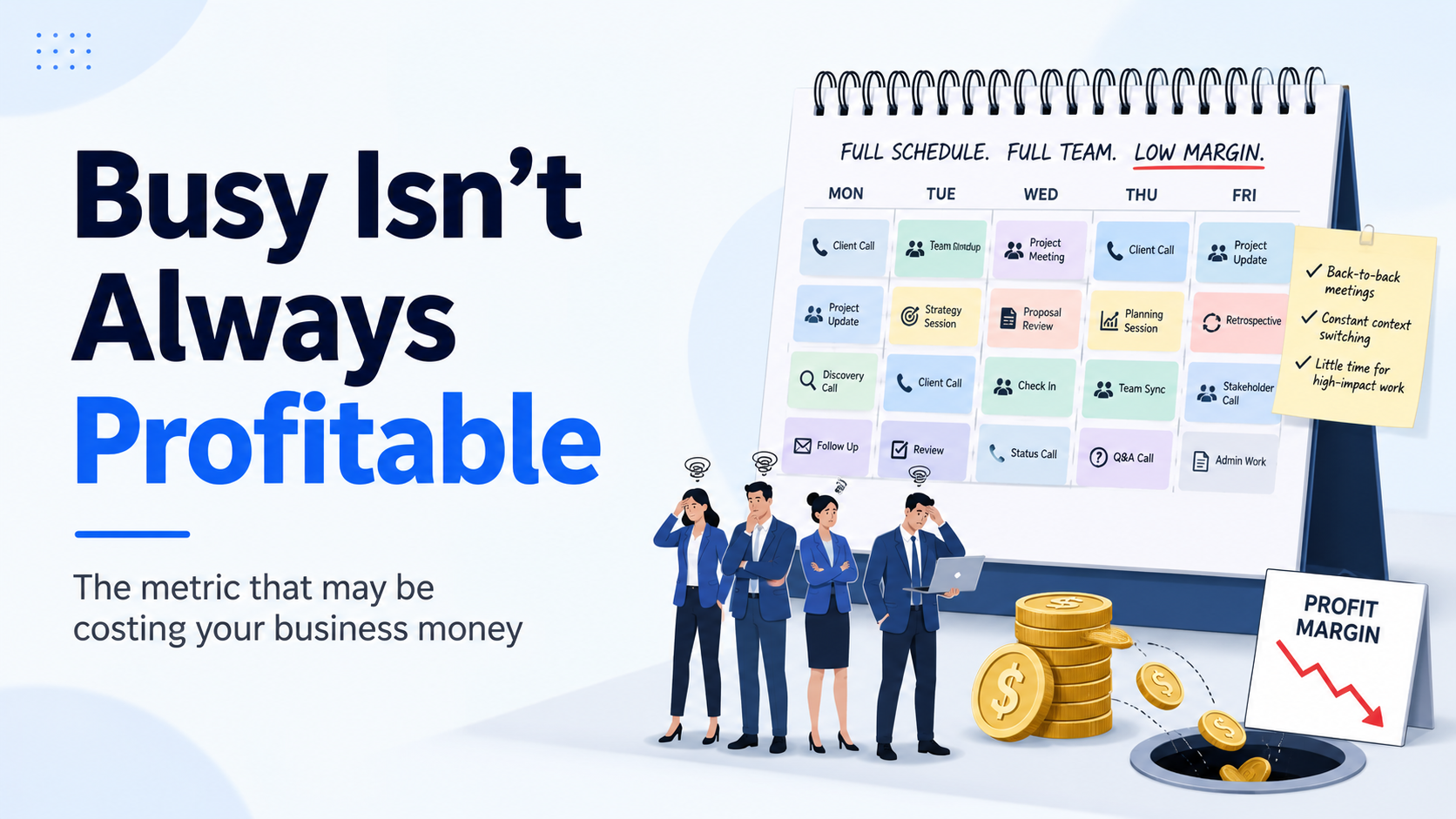
Busy Can Hide a Capacity Problem
There is a difference between having a productive team and having a team with no room to move.
When every person is operating at 100% capacity, even a small disruption can create a ripple effect.
A customer asks for something unexpected.
Someone calls out sick.
A project takes longer than estimated.
A new opportunity comes in.
Suddenly the entire schedule starts slipping.
Deadlines move. Overtime creeps in. Customer response times get longer. Owners jump back into work they thought they had delegated.
That is not necessarily a people problem.
It is often a capacity planning problem.
Good business capacity planning is not about squeezing every available hour out of your employees. It is about making sure the available hours are being used on work that supports revenue, customer delivery, and profit.
Not All Work Deserves the Same Amount of Time
One of the biggest operational efficiency problems I see is that businesses treat nearly every task as equally important.
It is not.
A $150-an-hour employee spending three hours doing administrative work that could be automated or delegated is expensive.
A sales leader sitting through meetings that do not require their input is expensive.
A business owner solving routine customer issues because nobody else has clear authority to make the decision is very expensive.
The problem is rarely that people are not working hard enough.
The problem is that high-value capacity gets consumed by low-value work.
And because everyone looks busy, it is easy to miss.
The Cost Shows Up Somewhere
Eventually, overloaded capacity starts affecting the numbers.
You may see it through:
Increased payroll or overtime
Slower customer delivery
More mistakes and rework
Longer sales follow-up times
Projects taking longer than expected
Owners working more hours despite growing the team
Missed opportunities because nobody has room to take on something new
Revenue may still be growing during all of this.
That is what makes the problem deceptive.
You can grow sales while operational efficiency quietly gets worse.
Eventually, the additional revenue requires so much additional labor, management, and owner involvement that the profit does not grow at the same rate.
That is not the kind of profitable business growth most owners are working toward.
Before You Hire Someone Else, Look at the Work
When the team feels overloaded, the first reaction is often:
“We need another person.”
Sometimes that is absolutely true.
But before adding payroll, examine what the current team is actually doing.
Take a closer look at where the hours are going.
What work directly contributes to revenue or customer value?
What work exists because “that is how we have always done it”?
What could be automated?
What could be delegated to a lower-cost resource?
What could be standardized so it takes half the time?
What work could simply stop?
You may discover that you do not have a staffing shortage.
You have a work allocation problem.
That distinction can save a business a significant amount of money.
Build Capacity Before You Need It
The healthiest businesses usually have some breathing room built into their operations.
That does not mean employees are sitting around doing nothing.
It means the company has enough capacity to absorb growth, solve problems, take advantage of opportunities, and handle the unexpected without throwing the entire organization into chaos.
That flexibility is valuable.
It also gives leadership the ability to think ahead instead of constantly reacting to whatever is loudest today.
If your company wants profitable business growth, your operational systems have to create capacity, not consume all of it.
Stop Measuring Productivity by How Full the Calendar Looks
A full calendar may make everyone feel productive.
But the better question is:
What did all that activity actually produce?
Look at the outcomes.
Revenue generated.
Margin protected.
Customers retained.
Projects completed efficiently.
Sales opportunities advanced.
Owner dependency reduced.
Those are business metrics.
Busyness is simply activity.
If your team is constantly running at full speed but profit, delivery, and capacity are not improving with them, it may be time to look at where the business is spending its most valuable resource: time.
Find the Growth Priorities That Matter Most
You do not need to fix everything at once.
You do need to know which areas of your business are creating the biggest drag on profit, capacity, and growth.
The Profit Booster® Growth Map helps you identify where your biggest growth opportunities are hiding so you can focus your time and resources on the changes that can have the greatest impact.
Get your Profit Booster® Growth Map at:
https://profitbooster.biz/growthmap
About the Author

Marcia Riner is the go-to guru for all things business growth and greater profitability. With over 25 years of experience under her belt, she's the brains behind Infinite Profit®, where she's the CEO and business growth strategist. Her Profit Booster® methodology is the secret weapon for entrepreneurs hungry for more profit, growth, and a killer exit strategy that helps businesses outperform in today's challenging market.
Marcia hosts a weekly podcast called Profit With A Plan with videos on YouTube at www.Youtube.com/profitwithaplan and audio at www.profitwithaplan.com. She is constantly sharing business growth tips on all of her social channels @marciariner. You can also find her other blogs at www.infinite-profit.com/blog.