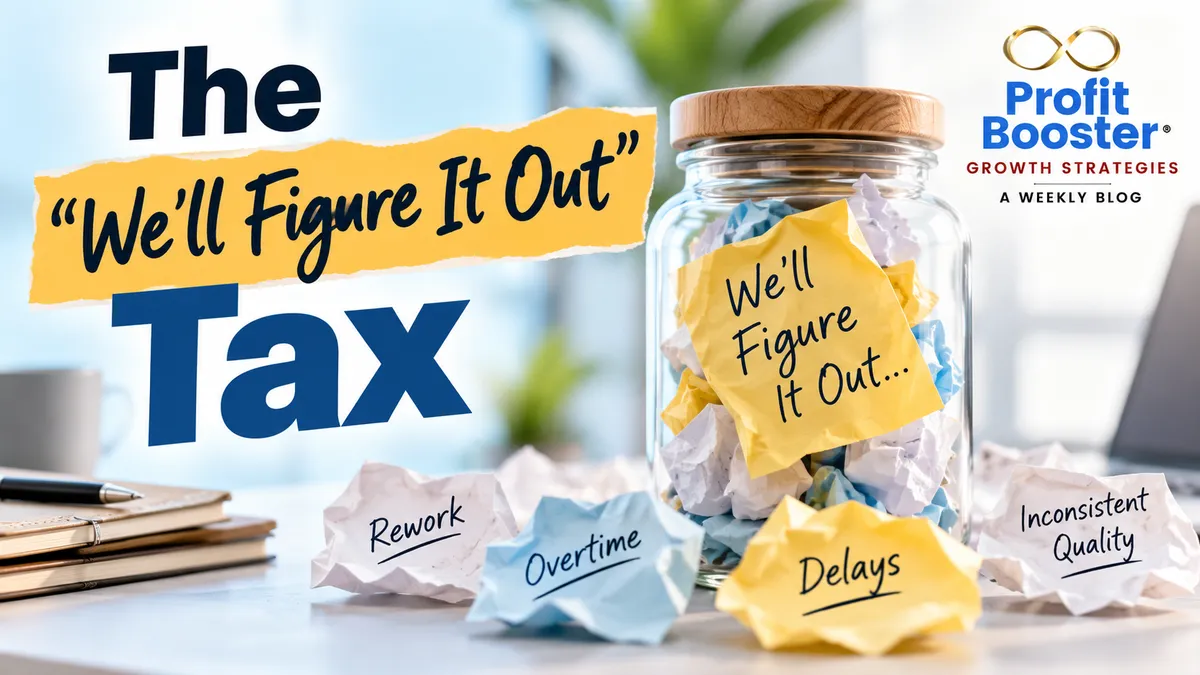
The “We’ll Figure It Out” Tax
The “We’ll Figure It Out” Tax
Profit Booster® Growth Strategies | Weekly Business Growth Blog
The hidden cost of running your business on improvisation, and how better processes can protect your profit margins without slowing your team down.
“We’ll figure it out.”
Four words that sound perfectly reasonable when you're running a growing business.
A customer needs something unusual. A team member runs into a problem. A deadline gets moved up. Someone asks how a particular situation should be handled.
And the answer? “We'll figure it out.”
Sometimes that's exactly what good business owners do. They adapt, solve problems, and keep things moving.
But when figuring it out becomes your company's standard operating procedure, you're paying a tax you probably aren't tracking.
And that tax is coming straight out of your profits.
When Flexibility Becomes an Expensive Habit
There's a difference between being adaptable and being unprepared.
Adaptability means your team knows the process and can make smart adjustments when circumstances change.
Improvisation means nobody is quite sure what happens next.
Here's how that plays out.
Your sales team promises a customer something operations wasn't expecting. Operations makes adjustments to deliver. Someone works late to accommodate the changes. The customer gets what they ordered, but it takes twice the effort you originally estimated.
Everyone celebrates getting the job done.
Meanwhile, your profit margin just took another hit.
Multiply that across dozens of customers, projects, and team members, and those little adjustments become a significant operating expense.
The dangerous part? Your financial statements probably don't have a line item called “We Figured It Out.”
What Is the Real Cost of Inconsistent Business Processes?
Inconsistent business processes increase costs through duplicated work, preventable mistakes, overtime, delays, and unpredictable service delivery.
These expenses rarely arrive as one large bill. They accumulate quietly.
Consider a service business completing 100 jobs each month.
If just 20 jobs require an extra hour of employee time because of missing information, unclear instructions, or preventable rework, that's 20 additional labor hours.
At a fully loaded labor cost of $40 per hour, you're spending an extra $800 monthly.
20
Extra hours/month
$800
Monthly waste
$9,600
Annual cost
Illustrative example based on 20 extra hours monthly at $40 per hour.
That's $9,600 annually from one small operational gap.
Now consider the other places where your business may be absorbing similar costs.
It's not difficult to see how operational inconsistency can consume thousands of dollars in profit without anyone recognizing the pattern.
Your Best Employees May Be Paying the Highest Price
Here's something business owners don't always consider.
When processes are inconsistent, your most capable employees often become the unofficial repair department.
They're the people everyone calls when something goes wrong. They know the shortcuts, remember the customer preferences, and understand how to get things done when instructions are missing.
Sounds like a great team, right?
Until those employees become overloaded, frustrated, and eventually leave.
Now you've lost institutional knowledge along with a valuable employee.
A business that depends on its best people constantly saving the day doesn't have a people problem. It has a process problem.
And hiring more people won't necessarily fix it.
How Can Business Process Improvement Increase Profit Margins?
Business process improvement increases profitability by reducing unnecessary labor, preventing errors, improving delivery consistency, and making better use of existing capacity.
You don't need a 100-page operations manual to make meaningful improvements.
Start by identifying where your team regularly has to improvise.
Ask three questions:
Where do we repeatedly have to fix something? Look for recurring customer complaints, incomplete handoffs, missing information, and repeated corrections.
Where are employees making the same decisions differently? Identify situations where inconsistent approaches create confusion, delays, or unnecessary costs.
Where does work slow down because nobody knows who owns the next step? Unclear responsibility is one of the easiest ways to lose momentum and profitability.
Choose one recurring issue and create a simple, repeatable process to prevent it.
Document the steps. Assign ownership. Make sure everyone understands the expected outcome.
Then measure whether the problem happens less frequently.
That's operational improvement without unnecessary complexity.
Standardization Doesn't Mean Losing Flexibility
Some business owners resist standardized processes because they worry their company will become rigid or bureaucratic.
But good systems don't eliminate flexibility.
They create room for it.
When routine activities happen consistently, employees spend less time correcting preventable mistakes and more time handling the situations that genuinely require judgment.
Customers receive more reliable service. New employees get productive faster. Managers spend less time putting out fires.
And owners gain something particularly valuable: a business that can operate effectively without their constant involvement.
That's not just better operational efficiency.
It's a stronger foundation for profitable business growth and long-term business value.
Stop Celebrating the Rescue. Start Preventing the Problem.
There's nothing wrong with having a team that can pull together and solve an unexpected problem.
But if every week requires another heroic effort, something needs attention.
The goal isn't to eliminate every surprise.
It's to stop paying repeatedly for the ones you could have prevented.
Take a look at the last 30 days in your business. Where did your team spend extra time fixing, correcting, chasing, or redoing work?
That might be where your next profit improvement is hiding.
And unlike finding more customers, fixing that operational leak may improve your bottom line without adding a single new sale.
Ready to Find What's Quietly Eating Your Profits?
Your next growth opportunity may not require a bigger marketing budget, more employees, or another new initiative.
It may simply require fixing what's already costing you money.
The Profit Booster® Growth Map helps you identify where your business has opportunities to improve profitability, strengthen operations, and build a smarter path to growth.
Before you invest more money into growing your business, make sure you're keeping more of what you already earn.
Get Your Profit Booster® Growth Map here.
About the Author
Marcia Riner is a Business Growth Strategist and CEO of Infinite Profit®. With more than 25 years of experience helping business owners increase revenue, improve profitability, and build stronger companies, she serves as a Growth Implementation Partner, helping entrepreneurs turn smart strategies into measurable results.
Through her Profit Booster® frameworks and Growth Agency, Marcia helps businesses identify missed opportunities, improve operations, implement growth systems, and create long-term business value.
She is also the host of Profit With A Plan, a weekly podcast featuring actionable strategies and conversations with business experts. Learn more at Infinite Profit® and explore additional articles at Infinite Profit® Blog.