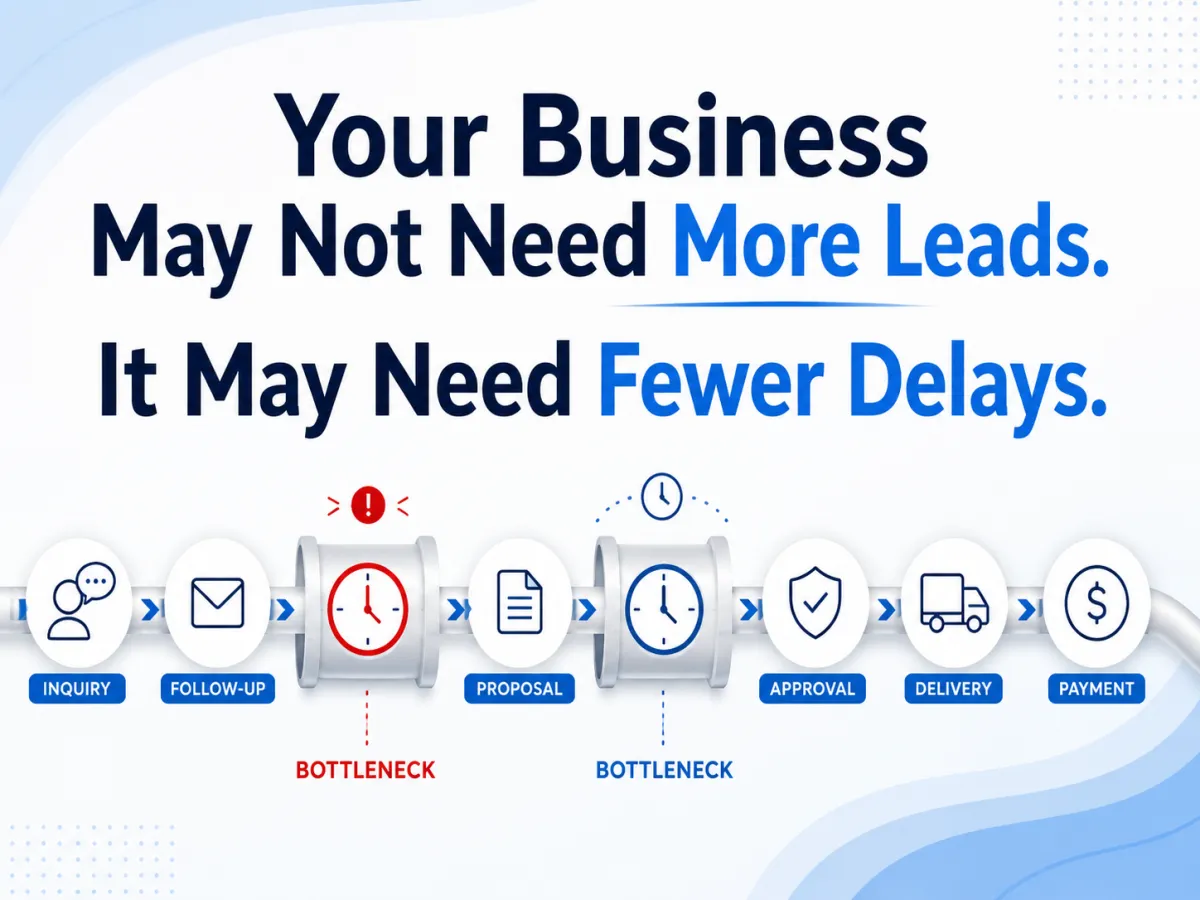
Your Business May Not Need More Leads. It May Need Fewer Delays. | Infinite Profit
Your Business May Not Need More Leads. It May Need Fewer Delays.
Most business owners know exactly what to do when they want more revenue.
Get more leads.
Run another campaign. Post more content. Increase the ad budget. Attend another networking event. Ask for referrals.
Sometimes that is exactly what the business needs.
But before you spend another dollar generating demand, there is another number worth looking at:
How long does it take someone to move from interested to paid?
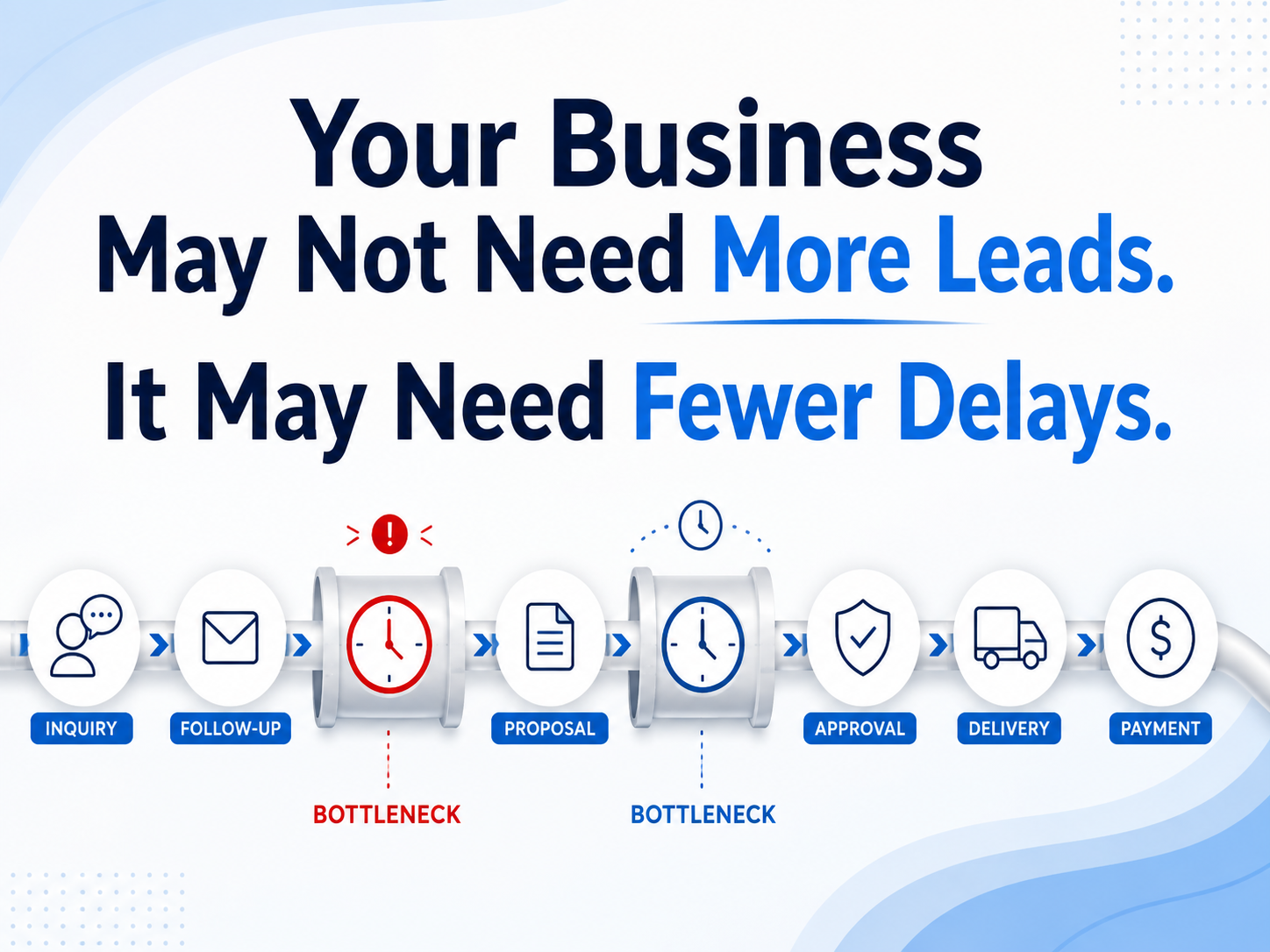
Because a surprisingly large amount of revenue can get stuck in the gaps between inquiry, response, proposal, decision, delivery, and payment.
You may not have a lead problem at all.
You may have a delay problem.
The Sale Often Slows Down Long Before the Customer Says No
Imagine someone fills out your contact form on Monday morning.
They are interested. Maybe even ready to buy.
Nobody responds until Tuesday afternoon.
A call happens Thursday.
The proposal goes out the following Monday because someone had to "get a few numbers together."
The prospect has a question Tuesday. The answer comes Thursday.
Then the proposal sits waiting for approval.
What looked like an active opportunity has suddenly taken two or three weeks to move a few simple steps.
Meanwhile, the prospect's enthusiasm has cooled. Another company may have responded faster. A new priority may have landed on their desk.
Nothing dramatic happened.
There was simply too much dead space.
That dead space can quietly destroy lead conversion.
Every Delay Gives Momentum a Chance to Disappear
Sales follow-up is not only about remembering to contact someone.
Timing matters.
A prospect who just raised their hand is thinking about the problem right now. They are more likely to answer the phone, reply to an email, review an offer, or make a decision while that need is fresh.
Wait several days and you are asking them to restart the buying conversation mentally.
That creates friction.
The same problem can happen after the proposal is accepted.
Maybe onboarding takes a week.
Maybe the project cannot start for another month.
Maybe the work is complete, but the invoice does not go out for five days.
Maybe invoices are sent promptly, but nobody follows up on unpaid balances.
Individually, these delays can look harmless.
Together, they stretch the distance between marketing activity and actual cash in the bank.
That affects your entire revenue growth strategy.
Find the Waiting Rooms Inside Your Business
One of the simplest growth exercises you can run is to map the customer journey and look specifically for waiting time.
Start with the first inquiry and follow the money all the way through payment.
Ask:
How quickly does a new lead receive a response?
How long until they can book a conversation?
How much time passes between the call and the proposal?
What happens after the proposal is sent?
How quickly can a new customer begin?
When is the invoice created?
How long does payment typically take?
Then look for the places where nothing productive is happening.
Those are your business waiting rooms.
Some may be caused by people. Others by unclear processes, manual handoffs, approval bottlenecks, overloaded calendars, or technology that was never set up properly.
You do not necessarily need to eliminate every delay.
You need to remove the unnecessary ones.
Speed Does Not Mean Rushing
There is an important difference between moving faster and becoming sloppy.
Nobody wants rushed proposals, chaotic onboarding, or a team firing off half-baked responses just to hit an arbitrary speed target.
The goal is less friction, not frantic activity.
For example, a stronger sales follow-up process might include an immediate confirmation when someone inquires, a defined response window for your team, proposal templates that eliminate unnecessary rebuilding, automated reminders, and clear ownership for each next step.
On the delivery side, it could mean collecting required information before the kickoff call, creating a standard onboarding sequence, or invoicing automatically when a milestone is completed.
Small operational improvements can shorten the revenue cycle without adding more work.
In many cases, they actually remove work.
Before You Ask Marketing for More Leads, Check the Ones You Already Have
More leads flowing into a slow system may simply create a larger backlog.
Your team gets busier.
Follow-up gets slower.
Prospects wait longer.
Conversion drops.
Then the assumption becomes, "We need even more leads."
That can turn into a very expensive cycle.
A better revenue growth strategy is to first make sure the business is converting demand efficiently.
If you shortened your average response time, proposal turnaround, onboarding lag, or payment cycle, what would happen to revenue without generating one additional lead?
That is the question worth answering.
Find the Growth Constraint Before You Add More Activity
Your next growth opportunity may already be inside your current pipeline.
It could be sitting in an unanswered inquiry, an unfinished proposal, a slow approval process, an onboarding queue, or an invoice that has not been followed up on.
The Profit Booster® Growth Map helps you identify where your business is losing momentum and which growth priority deserves attention first, so you can improve revenue without simply piling more activity onto the business.
Create your Profit Booster® Growth Map at:
https://profitbooster.biz/growthmap
About the Author

Marcia Riner is the go-to guru for all things business growth and greater profitability. With over 25 years of experience under her belt, she's the brains behind Infinite Profit®, where she's the CEO and business growth strategist. Her Profit Booster® methodology is the secret weapon for entrepreneurs hungry for more profit, growth, and a killer exit strategy that helps businesses outperform in today's challenging market.
Marcia hosts a weekly podcast called Profit With A Plan, with videos on YouTube at www.YouTube.com/profitwithaplan and audio at www.profitwithaplan.com. She is constantly sharing business growth tips on all of her social channels @marciariner. You can also find her other blogs at www.infinite-profit.com/blog.